








Tataki-Style Beef with Potatoes & Japanese Vinaigrette
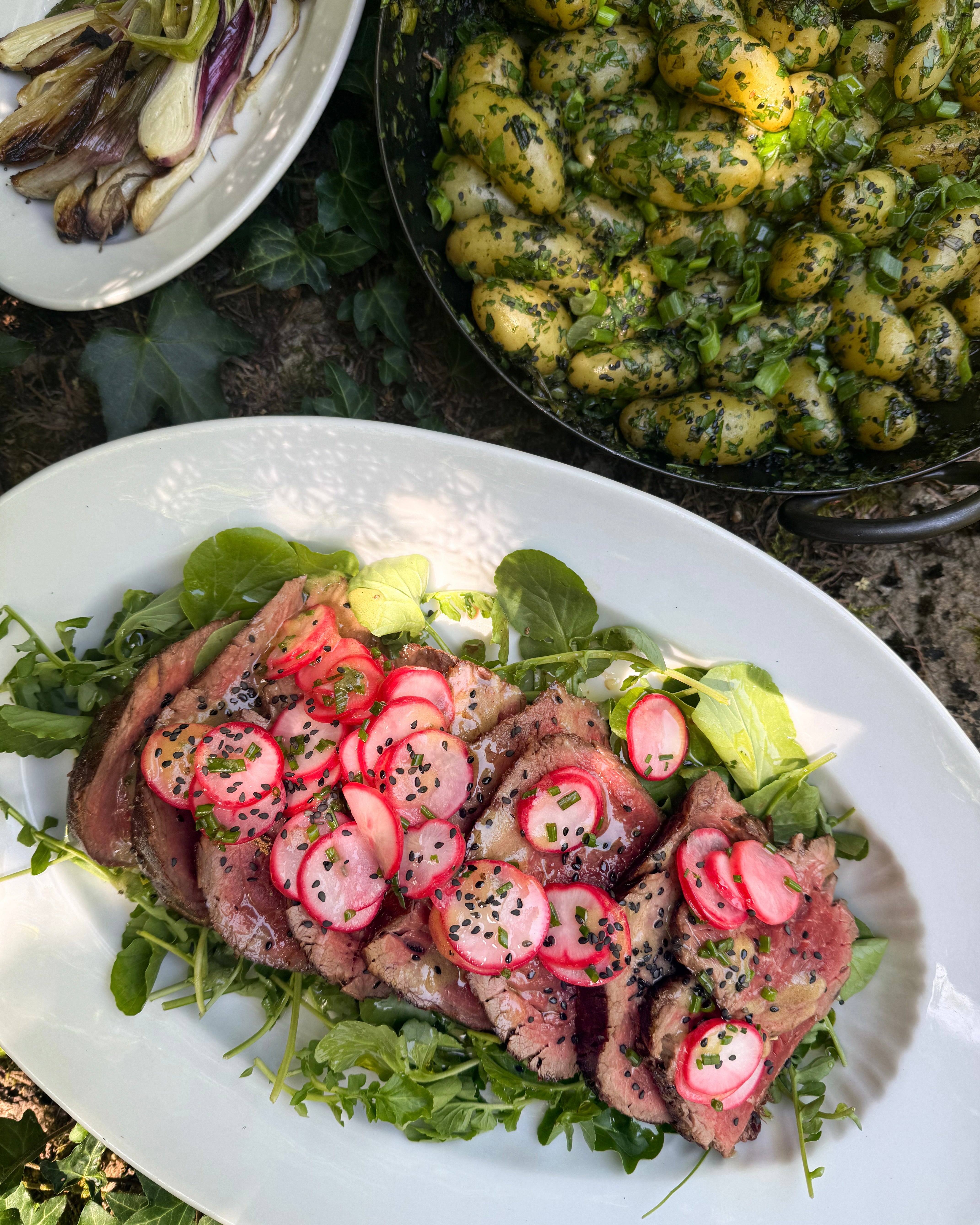
In Japanese cuisine, tataki can refer to meat that’s been beautifully caramelized on the outside but left extremely rare in the center, then sliced thin, for a presentation that’s somewhere between grilled steak and carpaccio. We love making it outside in the summer as part of a bright salad, because it becomes a rather light take on beef than can be served even on a warm evening. Here, we serve the tender beef over fresh greens with a miso-spiked vinaigrette, alongside herbed potatoes you can also warm the same way you sear the beef. Look for the highest quality meat you can find for this.
Tataki is a recipe we often edit to whatever flavors we feel like eating. For a light miso flavor, just use one tablespoon of miso, or more for a stronger punch. Use white wine vinegar for a bolder acid component, or rice wine vinegar for something more subtle. We sometimes drizzle the finished dish with toasted sesame oil, too. Use black or white sesame seeds, or none at all.
Ingredients
Serves 6
- For the beef:
- 1 (about 3-pound / 1.3-kg) beef tenderloin
- Fleur de sel
- 1 tablespoon extra-virgin olive oil, plus more for drizzling
- 3 large handfuls tender fresh arugula, mizuna or watercress
- Freshly ground black pepper
- For the potatoes:
- 2 pounds (910 g) whole yellow fingerling or small (about 1 inch/2.5 cm), yellow-fleshed new potatoes
- Fleur de sel and freshly ground black pepper
- 1 cup thinly sliced daikon radish or French breakfast radish
- 1/4 cup white wine or rice wine vinegar
- 3/4 cup extra-virgin olive oil, plus more for drizzling
- 1 to 3 tablespoons good quality Japanese white miso (to taste)
- 1 large handful fresh flat-leaf parsley leaves, finely chopped
- 1 large handful fresh cilantro leaves, finely chopped
- 1 bunch fresh chives, finely chopped
- 5 fresh scallions or spring onions, green parts only, finely chopped
- 1 tablespoon black or white sesame seeds (optional)
Preparation
1. Remove the tenderloin from the refrigerator and let it come to room temperature before grilling, about 1 hour.
2. Prepare a gas, wood, or charcoal grill for cooking over medium-high heat, to about 425°F (220°C), or until the fire has burned down to glowing coals. While the grill heats, prepare the potatoes.
3. In a large saucepan or small soup pot, combine the potatoes with cold water to cover by about 1 inch (2.5 cm). Add a small handful of salt. Bring to a boil over high heat, then once boiling, cook until tender when tested with a small sharp knife, 10 to 12 minutes (or more for larger potatoes). Transfer the potatoes to a colander to drain, then set the potatoes aside.
4. While the potatoes cook, make the vinaigrette: In a small bowl, combine the radish and the white wine vinegar with a pinch of salt. Leave to pickle for 10 to 15 minutes to pickle slightly (or up to 4 hours. Then remove the radishes from the vinaigrette and place in a small bowl and set aside. Add the olive oil and miso to taste to the vinegar and whisk to combine. Season with salt and pepper. (Miso pastes vary a lot in saltiness, so be sure to taste before you season.)
5. Tie the tenderloin to secure the meat for even roasting according to the instructions under Cook’s Note below. Dry the meat well with paper towels and season liberally with salt (about 1 tablespoon).
6. Once the gas grill is hot, or you have red hot embers with no flame, brush the grill grate clean. Drizzle olive oil over the tenderloin and rub it in with your hands. Add the beef and grill, turning occasionally, until browned and caramelized on all sides (including the ends), about 20 to 30 minutes total. (This will really depend on the shape of your meat.) The meat should register around 113°F to 115°F (45°C to 46°C) and should still be quite rare in the center. (If you prefer the meat more cooked, transfer the seared meat to the preheated oven in the pan, and roast until the meat registers 125°F / 51°C in the center, or is done to your liking, 15 to 20 minutes.) Let the beef rest 10 to 15 minutes on a wooden cutting board before carving.
7. While the meat rests, place the potatoes in a cast-iron skillet or other heatproof skillet. Place on the grill and begin to warm. Add just enough vinaigrette to the potatoes to coat and toss to coat all the potatoes thoroughly, then cook, stirring, until the potatoes are thoroughly warmed through. Add the herbs and toss to combine. Check for seasoning. Transfer the herbed potatoes to a warm bowl. Garnish with sesame seeds, if using.
8. When ready to serve, place the greens on a large serving board or platter. Remove the string from the meat. Using a sharp knife, carefully carve the beef into very thin slices. Arrange the slices on the greens. Season with salt and black pepper and drizzle with some of the remaining vinaigrette. (The rest of the vinaigrette can be passed at the table). Garnish with the pickled radish and serve alongside the warmed herbed potatoes. Enjoy warm or at room temperature.
Cook’s Note:
To tie a beef tenderloin into a roast: Start with the piece of meat, a sharp knife, and a roll of cotton butcher’s twine. Carefully trim any gray membrane (silver skin) from the meat, taking care not to remove too much fat. Place the meat on a cutting board with one short end nearest you. (If the meat is sort of triangular, the narrowest end should be closest to you.) Pat the meat into the shape you want to roast it in, folding under any thinner portions to create as even a shape as possible. (You may not need to do anything.) Cut an 8- to 10-foot (2.4- to 3-m) length of cotton butcher’s twine and bring it under the roast at the farthest end, about 1 inch (2.5 cm) from the end. Tie the string around the roast, making a regular square knot on top, so you’re left with one 2-inch (5-cm) piece and one very long piece of string. Working with the long end, twist the string to form a loop and slide the loop underneath the roast from the end closest to you, rearranging the string so it makes another pass around the roast about 1/2 inch (1.25 cm) below the first tie. Gently pull on the long end of the string to make the meat taut, rearranging the string as needed so that the intersection of the second tie lines up with the first knot and there is one straight piece of string underneath the meat.
Continue making loops and passing them underneath the meat, pulling gently to tighten around the meat at 1/2-inch (1.25-cm) intervals as you go. This will create a ladder of strings with one straight line down the center. If you’re tying a cut with a narrower end, tuck the narrow end underneath and loop the twine around both layers to create an even roast.
Keeping the remaining long string taut, turn the meat over and thread the long piece of twine over the first crosswise piece of string and under it, then over again, adjusting the string until taut. (This will keep the meat taut the long way.) Repeat the process—threading over, under, and over each crosswise string—until you reach the other end of the meat and the second side looks about like the first. Flip the meat back over and tie the end of the long piece of twine with the original short piece from the first knot, making sure it’s snug. Trim away any remaining twine so it looks nice and even.
Notes
Equipment